Own your sending.Get everything else.
RadarSend connects to the sending account you already run, with the same credentials, domains, and reputation, and adds the automation, segmentation, and bot-filtered reporting that self-hosted tools leave out. There’s no server to run.
Self-hosting can be a great option, up to a point.
The big-name platforms build sending into a per-contact price, so the bill grows faster than the list, and the reputation you build belongs to their account. Some review your content before it goes out, or pause accounts when a campaign looks risky to an algorithm.
Self-hosting avoids all of that. SES costs as little as $0.10 per 1,000 emails, the domains are yours, and you decide what gets sent. It works well until you need more than the tool can do, or the server starts to feel like a second job.
Where self-hosted tools usually get frustrating.
They stop at the send.
Tools like Sendy and Listmonk send broadcasts well, but they don’t follow up based on what people did or build audiences from behavior.
The ones with depth need a big server.
Mautic has real automation. It also needs a server with enough memory to run it, regular upgrades, and someone to fix the queue when a send stalls. Running your own mail server is a fine hobby. It’s a strange job.
The numbers are inflated.
55–60% of opens come through Apple Mail Privacy Protection (Litmus, July 2026), and security scanners click 80–95% of links in email sent to business inboxes (Omnivery, August 2026). Most self-hosted tools count all of it.
What you stop doing
- Server updates and security patchesHandled
- Cron jobs and queue workersHandled
- Backups and SSL renewalsHandled
- Bounce and complaint handlingHandled
- Warming new domains by handHandled
- Fixing a send that stalled overnightHandled
RadarSend runs all of it. You keep the sending account.
Your sending account doesn’t change.
Same sending account, same rate.
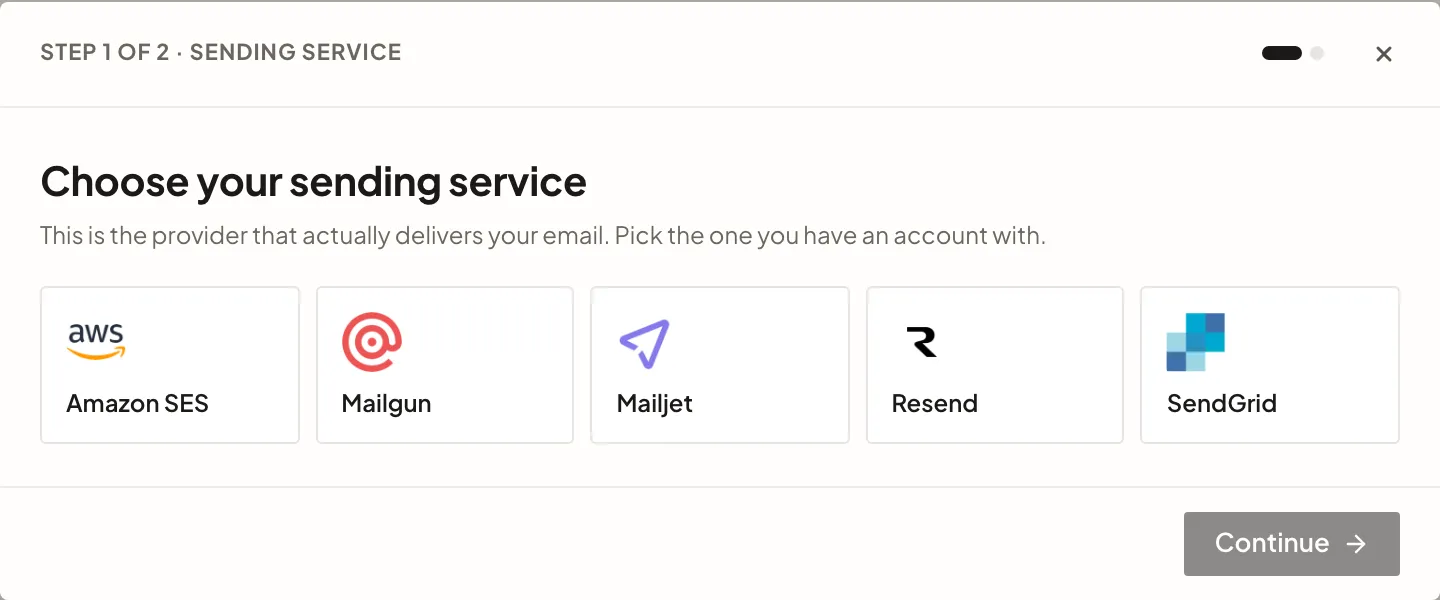
RadarSend connects to Amazon SES, SendGrid, Mailgun, Mailjet, or Resend. Email goes out on your account at your sending service’s rate, with the same credentials and domains.
Your domains, your brand.
Tracked links run through your own subdomain, and the unsubscribe page, preference center, and view-in-browser pages all sit on your domain. Recipients never see RadarSend’s name.
Your rules.
We don’t review your campaigns before they go out, so a send goes when you schedule it.
You can leave anytime.
We’d be sorry to see you go, but your sending account, domains, contacts, and reputation all go with you.
What comes after the send.
Broadcasts work fine on self-hosted tools. This is what comes next.
What happened after the click.
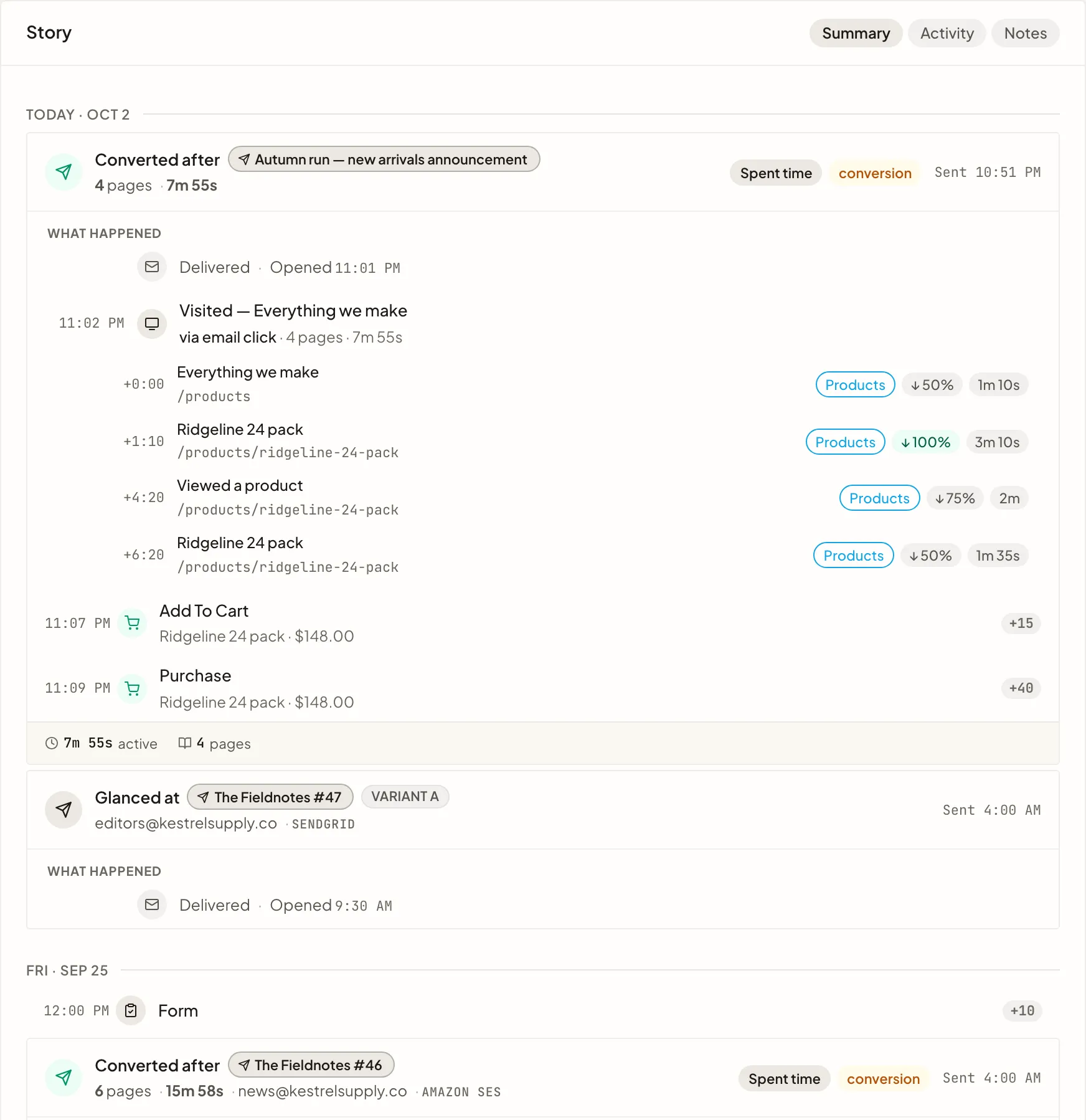
Most tools stop at "clicked." RadarSend shows that someone clicked, read three pages, spent nine minutes on your site, and came back two days later.
Follow-ups based on behavior.
A visit to your pricing page can start a follow-up three days later, and a month of silence can start a different one. Once a sequence is set up, it runs on its own.
Audiences that stay current.
Describe a segment once, like "clicked three recent issues but never bought," and people join and leave it as their behavior changes.
Reports that count people.
RadarSend labels every open and click as a person, a possible person, or a machine, and every report shows both numbers.
Scores and engagement.
Each contact gets a score and an engagement tier, and you can trace both back to the activity behind them.
Self-hosting isn’t free either.
The software may cost little or nothing, but running it doesn’t. Tools with real automation, like Mautic, need a server with enough memory to run well, and that can mean $50–$150 a month in hosting before you’ve sent a single email.
Then there’s the time it takes:
Uptime. When the server or a queue worker goes down, sends stall until someone notices.
Updates. Security patches and upgrades have to be applied, and they sometimes break things at a bad moment.
The small jobs. Cron jobs, bounce processing, backups, and certificate renewals all need someone keeping an eye on them.
With RadarSend, you don’t need to worry about that. You keep the same sending account and the same rate, and the server bill and the upkeep go away.
See what you’d pay →We expected a hosted platform to cost much more than our Mautic setup. RadarSend costs about what we were already spending on the server alone and we no longer have to maintain it.
Moving over from a self-hosted tool.
Connect the same sending account, and the import wizard brings over your contacts, lists, and unsubscribes. If you’d rather have help, we can handle the move for you at no charge.
Pick the path that fits.
Coming from Sendy?
Keep the SES account and add sequences, segments, and bot-filtered reports.
RadarSend vs SendyComing from Listmonk?
The same sending service and the same control, plus automation and scoring.
RadarSend vs ListmonkComing from Mautic?
The automation and scoring you’re used to, without the server.
RadarSend vs MauticBuilt something custom on SES?
RadarSend adds automation, segmentation, and bot-filtered reports to the sending service you already run.
See everything it does
Questions from self-hosted teams
Can I keep my SES account?
Yes. You connect the same account with its own access keys, and your existing domains, DKIM records, and sending reputation stay as they are.
Can I run both while I switch?
Yes. Keep sending from your current tool while you set up and test RadarSend, then move over when you’re ready.
What comes over from Sendy, Listmonk, or Mautic?
Contacts, custom fields, lists, unsubscribes, and suppressions come over with the import wizard. Templates and automations can be rebuilt, and we’re happy to help with those. Past reports stay in your old tool.
Can I try it first?
Yes. Monthly plans come with a 30-day money-back guarantee. If it isn’t the right fit, we’ll refund you in full.
Keep your sending account. Add everything else.
Same sending account, same domains, same reputation, with no server to run.
30-day money-back guarantee on monthly plans.