Keep your SES account. Add everything Sendy doesn’t do.
Sendy sends broadcasts through your own Amazon SES account. RadarSend connects to the same account and adds the follow-ups, segments, and reporting that Sendy leaves out, and there's no server to run.
Sendy is built for broadcasts.
It does that well, for a one-time $69. What happens after the send is up to you.
No sequences or automation
No segments built from site visits or scores
Bot opens and clicks counted as people
No history of what each contact read
Broadcasts only.
RadarSend adds the rest, on the same SES account.
Sequences that react to what someone did, segments that update themselves, a history of every email and page view for each contact, and opens and clicks with the bots taken out.
What Sendy can't do.
Sendy sends a broadcast and shows you the totals. RadarSend sends the same broadcast, keeps track of what each person did next, follows up on its own, and takes the bots out of every report.
Automatic follow-ups based on behavior.
Someone clicks a link in your newsletter and visits your pricing page. Three days later, RadarSend can check if they came back and send the right follow-up. Sendy's autoresponders go out on a timer from the day someone subscribed, so they can't react to what that person did.
Audiences that build themselves.
“Clicked three issues but never bought.” “Visited pricing twice this week.” Sendy’s segments filter on your list’s fields and last activity, and you can export who opened or clicked a campaign. RadarSend segments can also use site visits, scores, and events, and they stay current as people act.
A real record for each person.
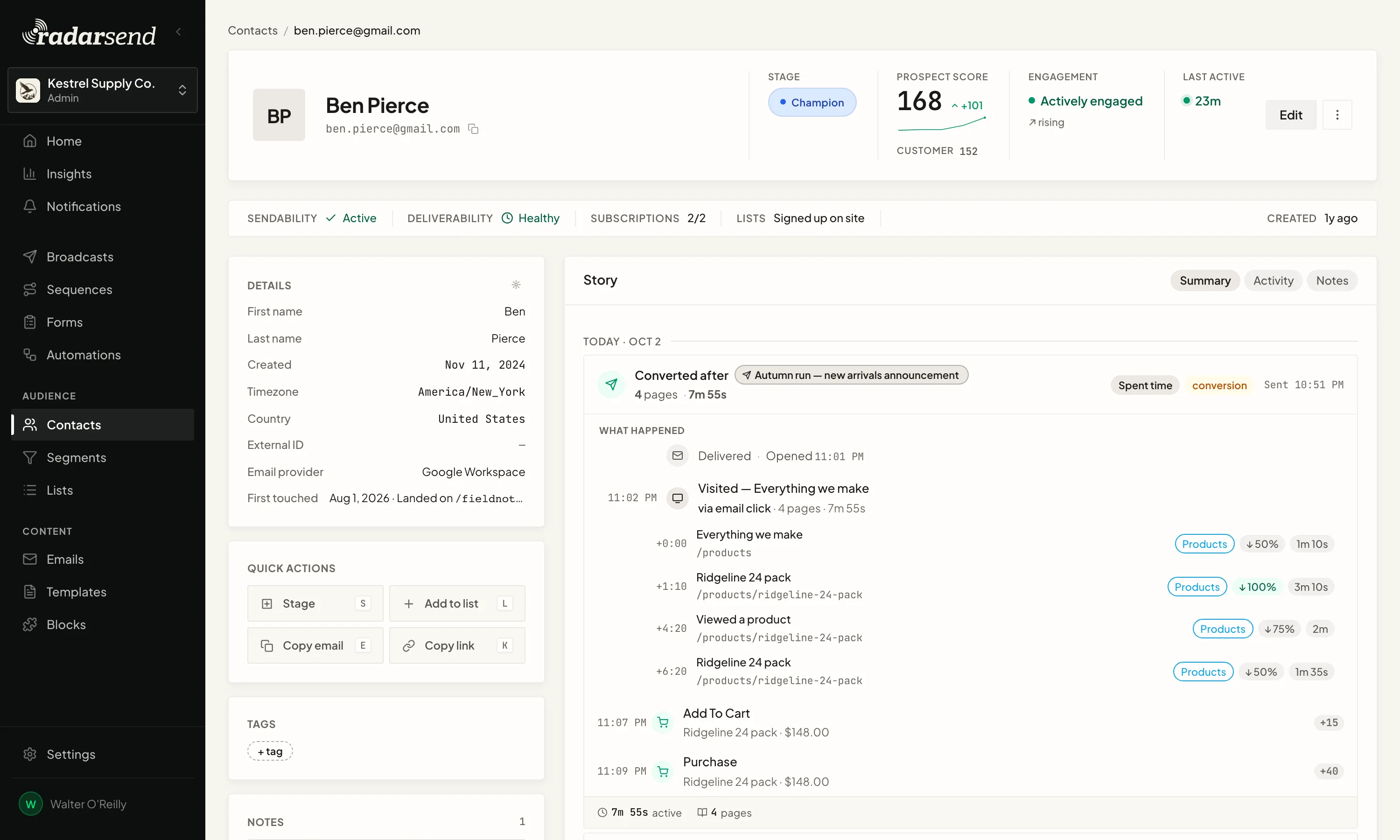
Every email you sent them, every click, every page they read on your site afterward, how long they stayed, and whether they came back days later. In Sendy, a subscriber is an email address, their fields, and their totals.
And the rest of what a growing list needs.
A/B tests on the subject, the whole email, the sender, or the sending service. Lead scores for each contact. Website analytics tied to the people you know. A full API with webhooks, and a connection for AI assistants like Claude.
Some of your opens and clicks come from machines.
55–60% of email opens now come through Apple Mail Privacy Protection, and about half of email clicks were bots by mid-2026, most of them security scanners. Sendy counts all of it as engagement.
RadarSend labels every open and click as a person, a possible person, or a machine, and shows both numbers on every report, so you can see how much of your engagement came from people.

Sendy costs less up front. Here’s what the difference buys.
Sendy is $69 once, plus the server you run it on. RadarSend starts at $49 a month, billed annually, and there’s nothing to host.
Your SES bill stays the same and the server bill goes away, so the monthly price pays for everything Sendy doesn’t do, and for not looking after a server. If broadcasts are the whole job and you don’t mind the upkeep, Sendy does that job well. If you need more than that, RadarSend adds it on the same SES account.
Switching doesn't touch your sending.
Your SES account.
RadarSend connects to the same Amazon SES account. Mail goes out on your account, at your rate, and the reputation it builds stays with your domains.
Your domains.
Tracked links, the unsubscribe page, and the preference center all run on your domain. Recipients never see RadarSend's name.
What you send.
We don’t review your campaigns before they go out, so a send goes when you schedule it.
Keep the SES account. Add everything else.
We’ll work with you to bring over your lists, custom fields, and suppressions. Your SES account stays exactly where it is, so you’re not moving your sending, only adding everything around it.
If you have questions about your setup, we’re always happy to walk through it with you. Just let us know what you have.