A Mailchimp alternative for less than half the price.
Mailchimp is inexpensive for small lists. At 25,000 contacts, Standard is $310 a month, and it still bills you for people who’ve unsubscribed. RadarSend sends through your own account, so the same list costs about $105 with Amazon SES.
Mailchimp’s price includes the sending.
Every email goes through Mailchimp’s own servers, so the per-contact price covers the sending too, and there’s no cheaper way to send the same list.
No lead scoring you can set up
Unsubscribes count toward the bill until you archive them
Sending only through Mailchimp’s servers
Sending can be held while an account is reviewed
Paying for the sending in the plan.
RadarSend is priced by list size, and your sending service handles the sending.
Every feature on every plan, sent through your own account at your sending service’s rate, and unsubscribed contacts never count toward your plan.
What the same list costs.
Mailchimp’s prices include sending through its own servers. Standard has advanced segments and multivariate tests, and Premium adds higher limits and phone support. RadarSend includes every feature on every plan, plus whatever your sending service charges.
Mailchimp list prices from its pricing page on September 29, 2026; new customers with 10,000 or more contacts get 15% off for their first 12 months. RadarSend figures are annual plan prices plus SES at four sends a month to the whole list, at $0.16 per 1,000.
At 25,000 contacts, Mailchimp Standard is $310 a month. RadarSend costs about $105. That’s about $205 a month, or over $2,400 a year. Mailchimp also bills for unsubscribed contacts until you archive them. On RadarSend, unsubscribed and archived contacts don’t count toward your plan.
The things you're already using work the same way.
Broadcasts.
Pick the audience, write the email, and send it now or schedule it. A/B test the subject, the whole email, or the sender. It works the way you’re used to.
Automation.
Sequences that send, wait, and branch, started by a signup, a date, a field change, or a score passing a number you set. The logic is the same as the flows you’ve built.
Segmentation.
Segments built from email activity, site visits, scores, fields, and events, and they update themselves as people act. Mailchimp’s advanced segments start on Standard; RadarSend’s are on every plan.
Reporting.
Delivery, opens, clicks, bounces, complaints, and unsubscribes, with results for each link, each A/B version, and each inbox provider.
Four things that work differently on RadarSend.
Lead scoring you set up.
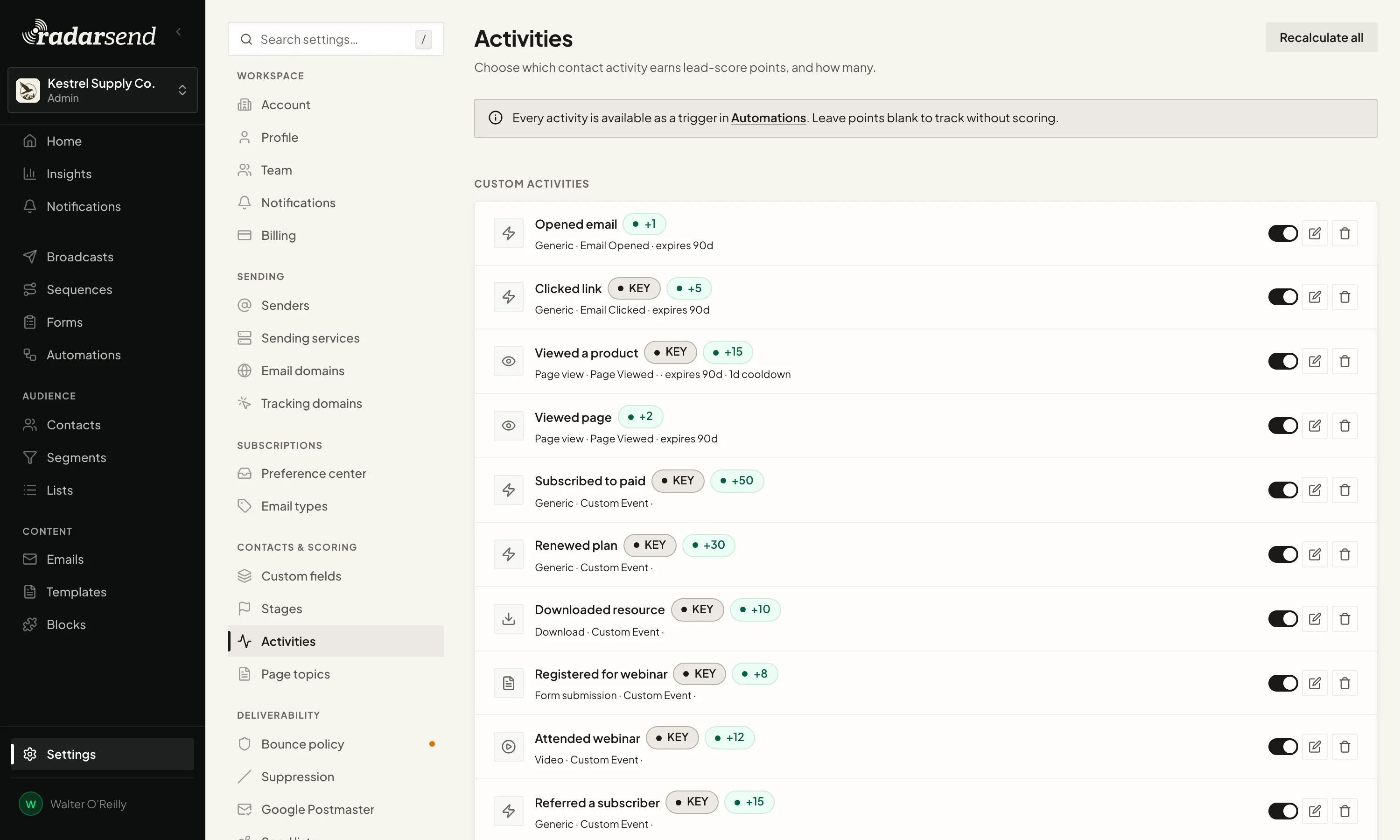
Mailchimp rates contacts from one to five stars based on their clicks, and adds purchase predictions if you connect a store. In RadarSend you decide what counts, like a demo request, a visit to your pricing page, or a webinar signup. Prospect and customer scores add up from those, you can see which actions earned every point, and a score can put someone in a segment or start a sequence.
Owned sending.
Mailchimp sends everything through its own servers. You can authenticate your domain, but you can’t choose the sending service. RadarSend connects to your own account, whether that’s Amazon SES, SendGrid, Mailgun, or another, and you pay its rate with no markup from us. Amazon SES costs as little as $0.10 per 1,000 emails, and if you ever leave, the account and its sending history stay with you.
No tier gates.
On Mailchimp, advanced segments, multivariate tests, and branching flows start on Standard, and Essentials caps a flow at four steps. RadarSend has one set of features, and every plan includes all of them: scoring, segments, A/B tests, website tracking, bot filtering, the API, and webhooks.
No review before you send.
Mailchimp’s automated checks look at imports and recent sends, and it can hold sending while it reviews an account. RadarSend doesn’t review your campaigns before they go out, so a send goes when you schedule it.
Where Mailchimp does more.
No drag-and-drop email builder.
Mailchimp has a drag-and-drop builder and ready-made templates. In RadarSend, your team designs templates once in MJML or HTML, and then you, or an AI assistant, fill in the words and images.
No free tier.
Mailchimp has a free plan for up to 250 contacts. RadarSend starts at $49 a month, and it’s built for teams that already know email works for them, not for someone at 500 contacts deciding whether to start.
Need a specific integration?
Mailchimp lists over 300 integrations, plus SMS, landing pages, and social posting. RadarSend has a full API, webhooks, a WordPress plugin, and a connection for AI assistants like Claude. If you need something connected that isn’t covered, we’re happy to help you work it out.
Priced by list size, not by sends.
We’ll work with you to move your contacts, custom fields, lists, and suppressions, and your email designs come across as HTML. Connecting an existing SES account takes about 15 minutes. If you’re new to SES, AWS usually approves full sending access in about a day, and we’re happy to walk you through it.
We’ll help you rebuild your Mailchimp flows as sequences, and if you have questions about your setup, we’re always happy to walk through it with you.